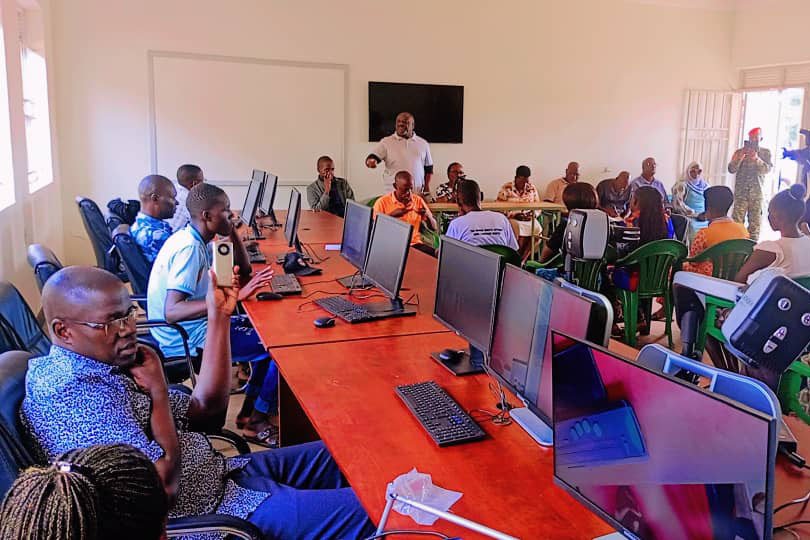
The Digitally Enabled Gender Equity and Social Inclusion (DEGESI) Project, funded by the UK Government’s Digital Access Programme (UK DAP) through the British High Commission, implemented by the African Centre for Women, Information and Communications Technology (ACWICT), and coordinated locally by NORRADS, played a transformative role in unlocking digital inclusion in Elgeyo Marakwet County. One of the most notable achievements under this collaboration was the activation and operationalisation of the Samich ICT Centre located in Chepkorio Ward, Keiyo South Sub-County.
The centre, constructed by the County Government, was a fully equipped facility with strong potential to serve as a community digital hub. In its early stages, however, public uptake was gradual as residents were still familiarising themselves with the services available and exploring how best to engage with them. The county government was also gradually working to get the human resources needed to make it operational. Local youth, although eager to learn, needed more structured avenues to begin their digital skilling journey. The foundation had been laid, and what remained was complementary support to accelerate community engagement. The Community Digital Champion (CDC) approach introduced by DEGESI strengthened this effort by providing locally rooted trainers who could connect the community to the centre’s opportunities in a relatable and consistent way.
The DEGESI Initiative: A New Door Opens
To activate the Samich ICT Centre, the County Government and NORRADS worked in partnership with CDCs who had been trained through UKDAP under the DEGESI initiative, using the ICT Authority’s (ICTA) national digital skilling curriculum. These CDCs had first undergone basic digital competencies training delivered by ACWICT at the national level. They were then equipped to cascade foundational digital skills to ordinary citizens in their home communities.
By stepping into the Samich ICT Centre as locally rooted trainers, the CDCs became the bridge between national digital skilling efforts and last-mile community uptake. Their leadership, mobilisation skills, and firsthand training approach brought the facility to life, supporting learners of all ages, including women, youth, older adults, smallholder farmers, and persons with disabilities. Through their presence, the centre gained the human expertise needed to make its services fully operational and meaningful to the community.
For many residents, it marked their first meaningful contact with digital services. A considerable number, 43% of all trainees, used eCitizen for the very first time, enabling them to apply for identification cards, birth certificates, bursaries, and NHIF services with confidence. At the same time, 32 young people submitted their first-ever online job applications after learning how to create email accounts, develop CVs, and navigate job portals.
What had once been an underutilised space soon experienced a steady rise in daily activity. Foot traffic increased from almost zero to an average of 25-40 users per day, firmly establishing the centre as a trusted destination for digital support and learning. Women’s participation expanded, aided by flexible training schedules and the presence of female CDCs who created a safe and encouraging learning environment. Older adults, many of whom had previously been hesitant about technology, began returning regularly for personalised one-on-one sessions that helped build their confidence and independence.
Among the many stories of transformation was that of Jane, a local mother who walked into the centre seeking help with her daughter’s bursary application. After successfully applying online, she returned days later, this time with two other mothers, eager to share what she had learned. Reflecting on her experience, she said, “I never imagined I could do this myself. This place has opened doors for us.” Her testimony reflected the centre’s growing role as a community enabler and a source of new opportunities.
A Visible Transformation
The CDC model did more than fill the centre with activity; it embedded it firmly into the social and economic fabric of Chepkorio Ward. Strengthened by DEGESI’s groundwork, the County Government of Elgeyo Marakwet officially launched the Samich ICT Centre as part of its broader effort to expand access to digital services and strengthen last-mile service delivery.
County officials reaffirmed that ICT centres such as Samich align directly with the County Integrated Development Plan (CIDP III) and the Kenya Kwanza Bottom-Up Economic Transformation Agenda (BETA). These centres are designed to promote digital inclusion, equip youth for online work, and strengthen the delivery of government services at the community level. Other leaders in attendance, including ICT Chief Officer Daniel Kimutai, Keiyo South Sub-County Administrator Meshack Bowen, and Chepkorio Ward Administrator Getrude Serem, echoed their commitment to ensuring that all ICT centres across the county are adequately equipped, fully functional, and accessible to every resident.
A Sustainable Pathway Forward
The revitalisation of the Samich ICT Centre illustrates a powerful truth: digital infrastructure is only as impactful as the people who animate it. Through the CDC model, DEGESI created a sustainable, community-driven ecosystem where skills could be shared, awareness could grow, and digital confidence could flourish organically. The centre no longer serves as a passive structure; it has become a living, active hub of learning and opportunity.
With CDCs continuing to serve as digital ambassadors in their villages and the county government committed to operationalising all 19 ICT hubs, the transformation witnessed in Chepkorio offers a scalable, replicable blueprint for digital inclusion across Elgeyo Marakwet County. Through strong partnerships, empowered youth leaders, and genuine community ownership, DEGESI has demonstrated that lasting digital transformation begins with people, especially when those people come from and serve their own communities.